A cultural deep-dive for travel agents preparing European clients for one of Vietnam’s most surprising — and most unforgettable — daily sights.
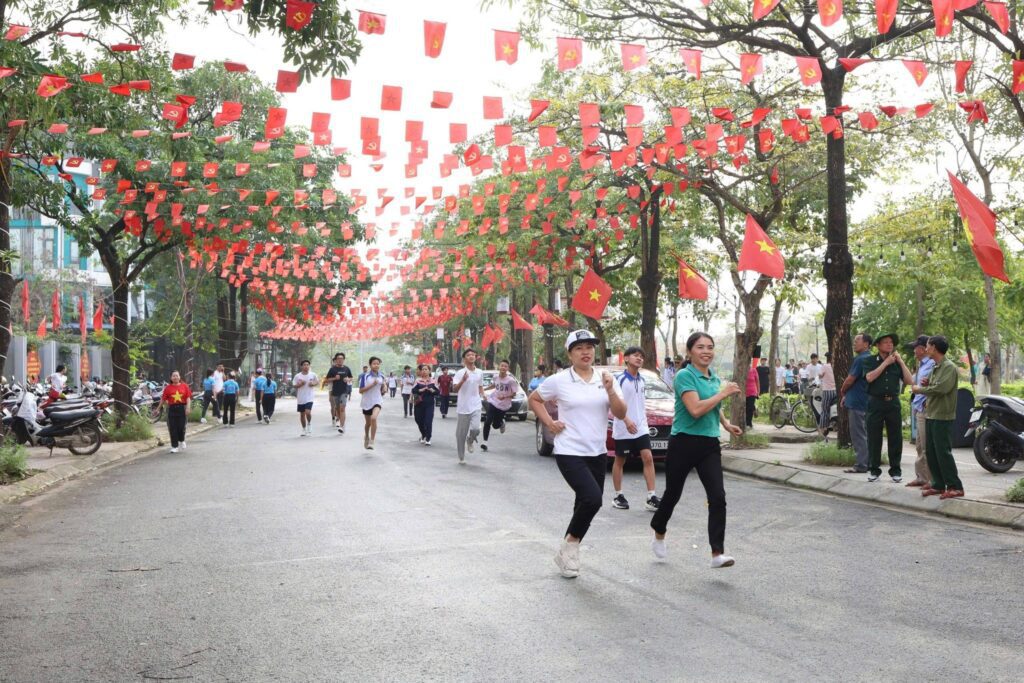
Picture this: a German couple steps out of their boutique hotel in Hanoi at six in the morning, hoping to find coffee before the city wakes up. Instead they find the city already wide awake — and not in the way they expected. By the lake, fifty older women in matching pastel tracksuits are moving in slow synchrony to a single loudspeaker.
Twenty metres on, a group of men in their seventies is playing shuttlecock with their feet. A father is doing pull-ups on a bright-blue outdoor gym frame while his teenage daughter stretches beside him. A class of forty is doing aerobics to Vietnamese pop music. It is 6:15 a.m. and it looks like half the city has been awake for hours. Vietnam morning exercise is one of the most extraordinary cultural collisions a Vietnam trip delivers.
For European travellers, this is one of the most extraordinary cultural collisions a Vietnam trip delivers. It’s not a performance. It’s not a tourist attraction. It’s a daily, deeply rooted rhythm that has shaped Vietnamese cities for generations — and as an agent, knowing how to brief your clients on it (and where to take them to see it) turns a logistical stop into one of the trip’s defining memories.
Vietnam Morning Exercise: What’s Actually Happening at Dawn
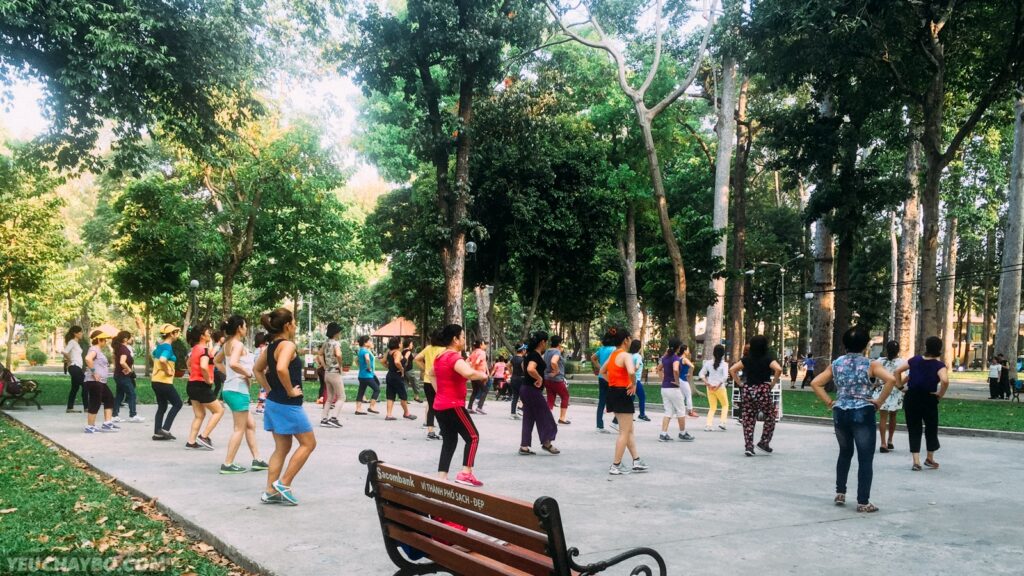
Vietnam morning exercise isn’t one activity — it’s a layered, overlapping set of practices, all happening in the same green space at the same time. Walk around Hoan Kiem Lake in Hanoi or Tao Dan Park in Saigon between 5:30 and 7:00 a.m. and you’ll find, often within thirty metres of one another:
- Tai chi groups performing the slow, flowing martial-arts forms refined over centuries into a health discipline. The movements look almost choreographed; they are.
- Aerobics classes with portable speakers, led by an instructor and following routines that change with the season. The music is loud, the energy is high, and the average age skews older than European clients tend to expect.
- Line and square dancers, typically women in their fifties and sixties, executing tightly rehearsed routines that blend Vietnamese folk movement with newer dance choreographies.
- Qigong practitioners, often quieter and more individual, focused on breath and the cultivation of internal energy.
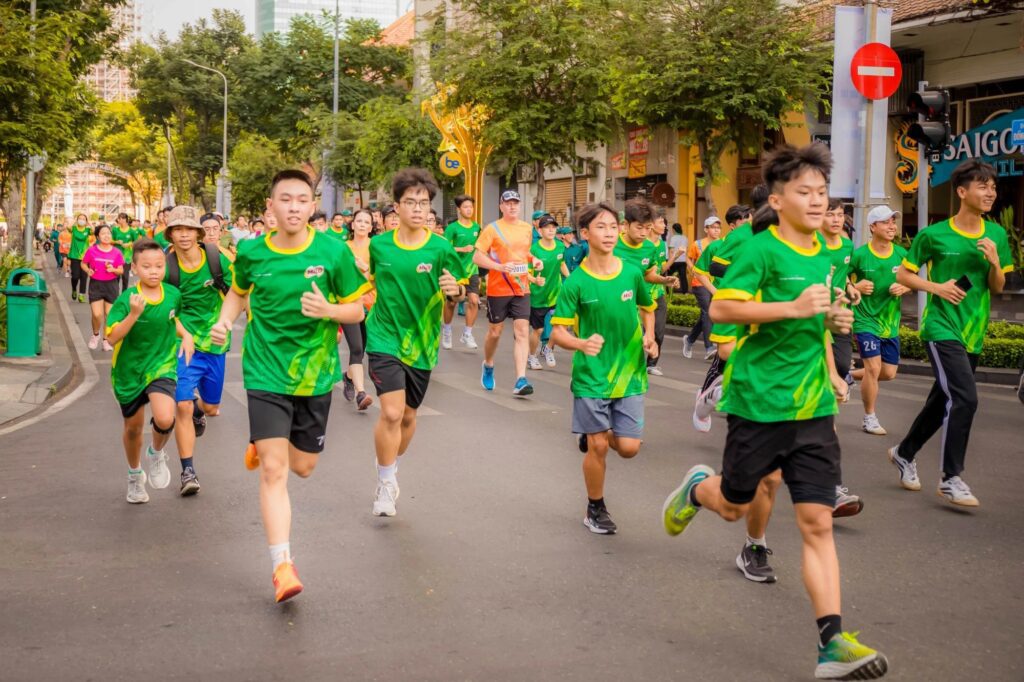
- Joggers and brisk walkers circling the lake or park perimeter, often in walking groups that have formed by neighbourhood.
- Shuttlecock-kick players — the Vietnamese game of đá cầu, where a feathered shuttle is kept airborne with the feet, knees, and shoulders. It looks like a cross between hacky-sack and football, and the older men who dominate it are astonishingly skilled.
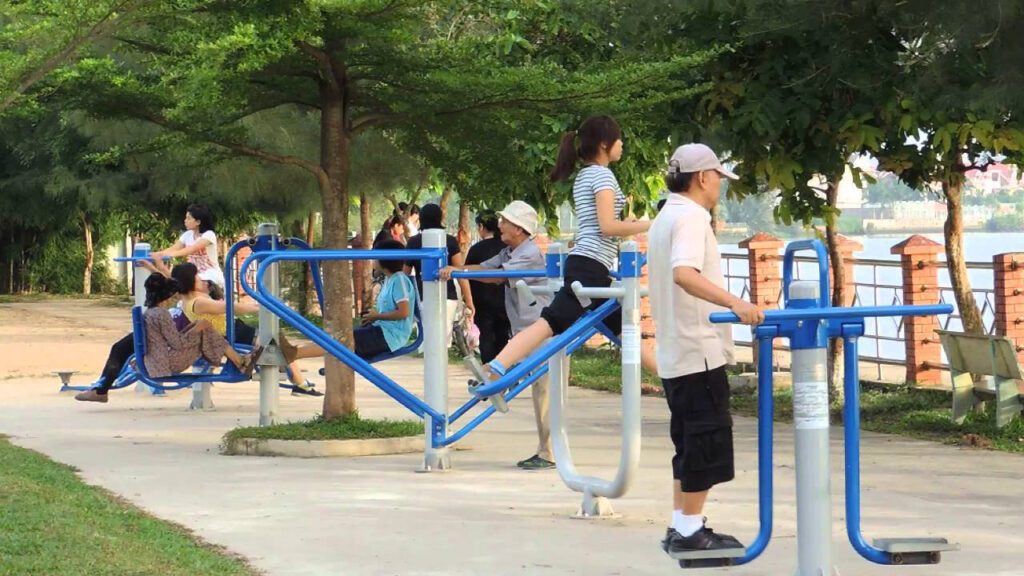
- People on the outdoor gym equipment — bright steel machines installed in nearly every public park, used by everyone from teenagers to grandparents.
All of this is happening simultaneously, with the cheerful chaos of multiple loudspeakers playing different music and absolutely no sense that this is unusual. Because it isn’t. This is how Vietnamese cities start the day. This is why morning exercise in Vietnam looks nothing like a European gym.
| “Vietnamese morning exercise isn’t one activity — it’s a layered, overlapping rhythm that has shaped these cities for generations.” |
Why Morning Exercise in Vietnam Is Always a Group Activity
To understand why a Vietnamese park looks the way it does at dawn, you have to set aside a key European assumption — that exercise is a private, individual project. In Vietnam, it has almost never been that. The reasons trace back through several converging traditions.
1. Confucian collectivism: the group is the self
Vietnamese culture sits at the meeting point of Confucian, Taoist, and Buddhist values, with a deep emphasis on the family and the community above the individual. Where Western fitness culture often frames exercise as a personal project — “my body, my goals, my schedule” — Vietnamese culture treats it as something you do together. The group is the unit. You exercise with your neighbourhood club, your former colleagues, your dance circle, your morning regulars. Social bonds aren’t a side effect of group exercise Vietnam offers — they’re the point.
2. Taoist mind-body balance and traditional health philosophy
Tai chi and qigong both stem from a centuries-old Asian view of health rooted in balance — between yin and yang, between movement and stillness, between the body and its surroundings. Traditional Vietnamese medicine, heavily influenced by Chinese thought, treats wellness as the maintenance of internal equilibrium. Gentle, sustained morning movement isn’t just exercise in this worldview; it’s preventive medicine, the daily tuning of an instrument.
This is why the dominant style of exercise you’ll see at dawn is slow, flowing, breath-focused, and inclusive of older bodies — a complete contrast to the high-intensity, sweat-driven gym culture European clients are used to.
3. The climate is also the calendar
Vietnam is hot for most of the year, and Saigon is hot for all of it. The window between dawn and 7:30 a.m. is the coolest, freshest, most workable part of the day. By 9 a.m. the air is heavy. By midday it is unworkable. Generations of Vietnamese have shaped daily rhythms around this reality — and the morning park ritual is one of the most visible consequences. In the evenings, when the heat lifts, the parks fill again with a second wave of practitioners.
4. A national health movement, decades in the making
Vietnam has long had a strong public-health and mass-sports culture, supported at the national and city level. Local wards, neighbourhood committees, and senior citizens’ clubs all organise exercise groups, and these clubs are a significant part of community life — particularly for retirees. In some communes, the morning club is the single most important social structure outside the family.
The result is a dense network of organised, sociable, low-cost group exercise that operates with virtually no commercial layer. There is no gym membership. No app. No personal trainer. Just a time, a place, and a community that turns up.
| AGENT INSIGHT When briefing European clients, the single most useful framing is this: Vietnamese morning exercise is a social institution that happens to involve movement, not a fitness routine that happens to be social. Clients who understand this go in curious rather than confused — and they’re far more likely to engage. |
Why this matters for European clients
There are a few specific reasons this is one of the most rewarding things a European traveller can witness in Vietnam.
It quietly dismantles stereotypes
Many European clients arrive with a soft mental image of Vietnam as either war-shadowed or beach-tropical. Watching a hundred grandmothers do disciplined synchronised aerobics at 6:30 a.m. while their teenage grandchildren do pull-ups on a public outdoor gym reframes the country instantly. It is modern, organised, healthy, communal, and intergenerational — adjectives that don’t always make it into the brochure.
It’s the most authentic kind of access
There is no entry fee, no ticket, no curated performance. Your clients are simply present in a space the city uses for itself. That’s increasingly rare in popular destinations, and travellers who care about authenticity feel the difference immediately.
It works for almost every client profile
Active travellers can join in. Photographers get extraordinary material. Older clients connect with peers their own age doing something they recognise (tai chi has European followings too). Honeymooners get a calm, beautiful shared moment before the day heats up. Families get a glimpse of intergenerational life that resonates with their own. There’s almost no client brief this experience doesn’t fit.
It’s free and time-efficient
From a programming perspective, this is an experience that costs nothing, takes no booking, fits before breakfast, and adds enormous emotional value to the day. For agents tightening budgets without sacrificing texture, it’s one of the highest return-on-effort experiences in Vietnam.
The bright-coloured machines: Vietnam’s public outdoor gyms
One of the first things European travellers notice — and one of the first things that needs explaining — is the outdoor gym equipment. You’ll find it in nearly every public park in Vietnam, painted in cheerful yellows, blues, and reds, often arranged in clusters of six to twelve stations.
Typical installations include:
- Elliptical-style “air walkers” for low-impact cardio.
- Static cycling frames.
- Twist boards and waist-rotation discs.
- Hip-and-leg push machines using body weight as resistance.
- Pull-up and dip bars, often used by younger users.
- Stretching ladders and arm wheels for upper-body mobility.
These gyms are part of a broader public-health programme that has rolled out across Vietnamese cities over the past fifteen years, with significant municipal investment. They are free to use, available at all hours, and built robustly enough to survive heavy daily use in tropical conditions.
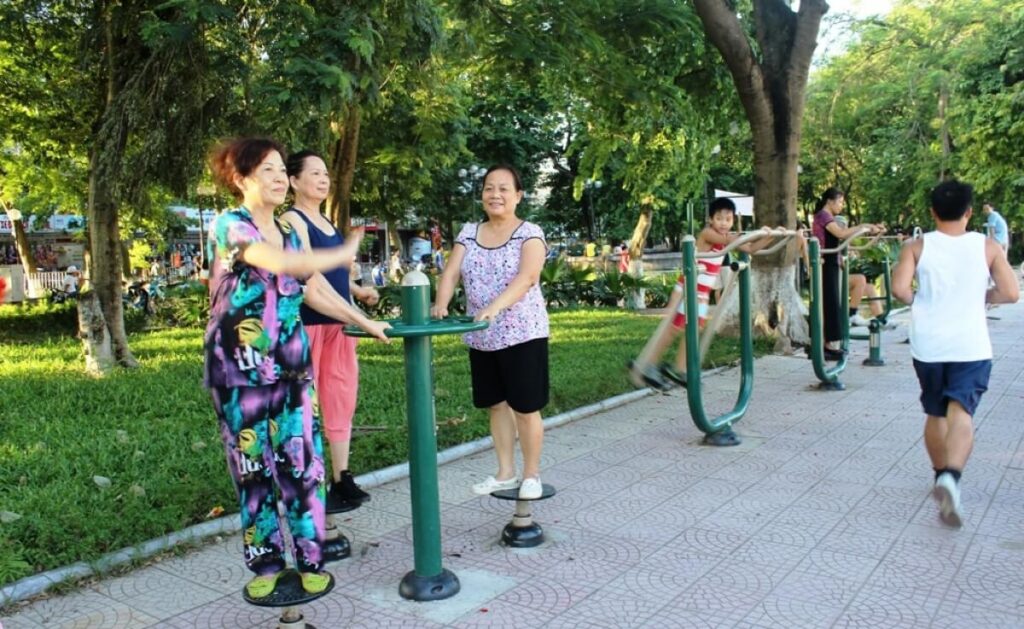
What’s most striking to European observers is who actually uses them. The European mental image of an outdoor gym tends to involve calisthenics influencers and shirtless young men. In Vietnam, you’ll see grandmothers patiently turning the waist-rotation disc, retired men reading the newspaper between sets on the leg press, and entire families using the equipment together as a kind of casual circuit. This is fitness infrastructure built for the whole population, not for the photogenic few.
| “This is fitness infrastructure built for the whole population, not for the photogenic few.” |
What your clients will see — and how to position it
Use this quick-reference table when briefing clients before the trip or talking them through the morning programme.
| What you’ll see | Where it comes from | What clients can do |
|---|---|---|
| Tai chi: slow, flowing synchronised movement | Chinese martial-arts heritage, refined for health over centuries | Stand at the back and follow along — instructors welcome quiet visitors |
| Group aerobics with loudspeakers | Modern Vietnamese mass-fitness culture, often organised by neighbourhood clubs | Watch from a bench with coffee, or step in if invited |
| Line and square dancing | Regional folk dance blended with newer choreographies | Wonderful photography material; some clients join the loose back row |
| Qigong and breathing exercises | Taoist mind-body tradition, focused on energy flow | Quiet observation; some practitioners speak basic English and explain |
| Badminton and shuttlecock kick (Đá cầu) | Traditional Vietnamese street game, played for generations | Easy participation — locals love bringing in foreign players |
| Outdoor gym equipment (bright steel machines) | Government-funded public health infrastructure rolled out across Vietnam | Free for anyone to use — clients can join the rotation |
Where to see it: the best parks for morning exercise watching
Hanoi
- Hoan Kiem Lake morning — the iconic hub for Hanoi morning tai chi and every other style of group exercise. The view of Thap Rua tower at sunrise is unforgettable.
- Ly Thai To Park, opposite the lake — large open space used heavily for group aerobics.
- Thong Nhat Park (Lenin Park) — a bigger green lung in Hanoi with mature trees, jogging paths, and several active morning communities.
Ho Chi Minh City (Saigon)
- Tao Dan Park exercise scene — Saigon’s most famous morning exercise park, with one of the richest dawn cultures in Vietnam Dense, varied, and home to the well-known “bird café” scene where local men bring caged songbirds to enjoy the dawn air alongside the exercise groups.
- 23/9 Park — central, accessible from most District 1 hotels, with a strong evening exercise scene as well.
- The Saigon River waterfront promenade — newer, with outdoor gym equipment installed during recent pedestrian-zone expansions.
Beyond the big cities
- My Khe Beach, Da Nang — beachfront tai chi and group aerobics at sunrise, with the South China Sea as the backdrop. One of the most photogenic morning settings in Vietnam.
- Han River promenade, Da Nang — joggers, walkers, and outdoor equipment stations along the riverbank.
- Xuan Huong Lake, Da Lat — a cooler-climate alternative where the morning chill makes for energetic group sessions.
How to programme this into a Vietnam itinerary
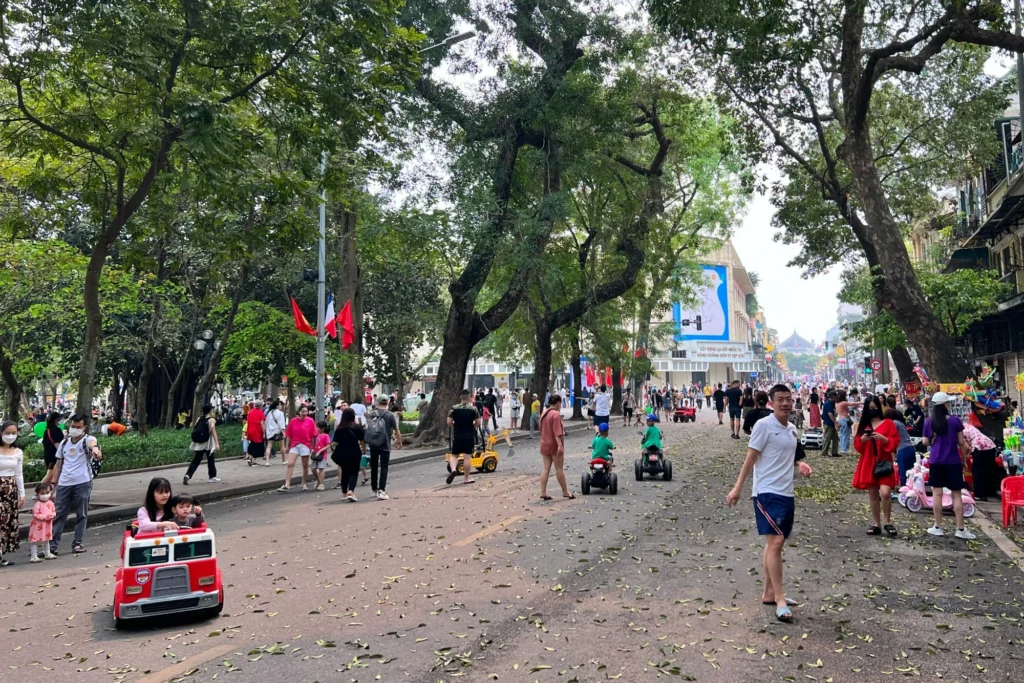
Vietnam morning exercise is one of the easiest cultural experiences to slot into a client itinerary. The good news is that this is one of the easiest cultural experiences to slot in. It costs nothing, takes no booking, and works as a soft, unhurried opener to a full day of sightseeing. A typical structure looks like this:
- 5:45 a.m. — early wake-up; clients meet their guide in the hotel lobby.
- 6:00 a.m. — short walk or transfer to the chosen park (Hoan Kiem in Hanoi, Tao Dan in Saigon).
- 6:00–7:00 a.m. — guided observation, cultural commentary, photography, and (if clients are willing) joining a tai chi group at the back.
- 7:00 a.m. — Vietnamese coffee or breakfast at a nearby café — phở, bánh mì, or a Vietnamese coffee with condensed milk.
- 8:00 a.m. — clients return to the hotel refreshed and ready for the day’s main programme, with a cultural experience already banked before breakfast.
VietOne’s Hanoi Half Day City Tour and Hanoi Full Day City Tour can both be preceded by an early-morning park visit at your request. For agents building bespoke Saigon programmes, the same idea pairs naturally with day tours from the packages portfolio or with the Vietnam Insider Journey (15 days) — and our Ho Chi Minh City group tour guide explains why southern Saigon is the easiest starting point for European groups looking for this kind of texture.
| BRIEFING TIP FOR CLIENTS Three things to tell your clients before they go. First, dress modestly — workout clothes are fine, but very revealing gym wear stands out. Second, if they want to join a group, smile and stand at the back; instructors will signal welcome. Third, photographing people is generally fine, but a smile or a quick gesture asking permission goes a long way and is almost always returned warmly. |

A note for honeymooners and families
For honeymooners, dawn at the lake is one of the most romantic and uncommercial things to do in a Vietnamese city — a shared, slow moment before the heat and the schedule arrive. It’s a beautiful counterweight to the more obvious romantic moments of a Vietnam trip, and it works particularly well as an opening day in Hanoi. The VietOne Vietnam Honeymoon guide has more on building itineraries with these kinds of texture moments.
For families, the morning park is a quiet revelation. Children get to see the outdoor gym equipment in use by all generations. Teenagers see an old people’s culture that isn’t sedentary. Parents see what an intergenerational outdoor city actually looks like. Everyone gets a story to bring home.
The bigger picture: why this matters for selling Vietnam in 2026
Wellness tourism, slow travel, and authentic local immersion are three of the most powerful drivers in the 2026 European outbound market. Vietnam morning exercise sits at the intersection of vietnam wellness tourism, vietnam slow travel, and authentic local immersion. It’s authentically local — nobody is performing for tourists. It’s wellness in the truest sense — preventive, gentle, communal. And it’s slow — it asks clients to stand still, watch, breathe, and notice. For travel agents looking to differentiate Vietnam from the generic Southeast Asia pitch, a dawn park visit is one of the most quietly powerful set-pieces available.
It’s also one of those experiences that travels well in word of mouth. A client who has come home from Vietnam talking about the lake at sunrise and the grandmothers in pastel tracksuits is a client who has done your marketing for you. That’s not a small thing.
For more on Vietnam’s evolving urban culture and how it shapes the agent’s pitch, our look at the end of Hanoi’s iconic Train Street is a useful companion read — the city is reshaping itself fast, and the morning parks are the constant beneath all the change.
| Build a Vietnam dawn experience into your next itinerary Your clients will remember many things about Vietnam, but the morning they joined a tai chi line at sunrise will be the moment they talk about back home. Let VietOne Travel build that moment into your itinerary — local guides, perfect timing, and the right park for the mood. Contact our Saigon team to discuss how to weave this into your next group or FIT programme. |