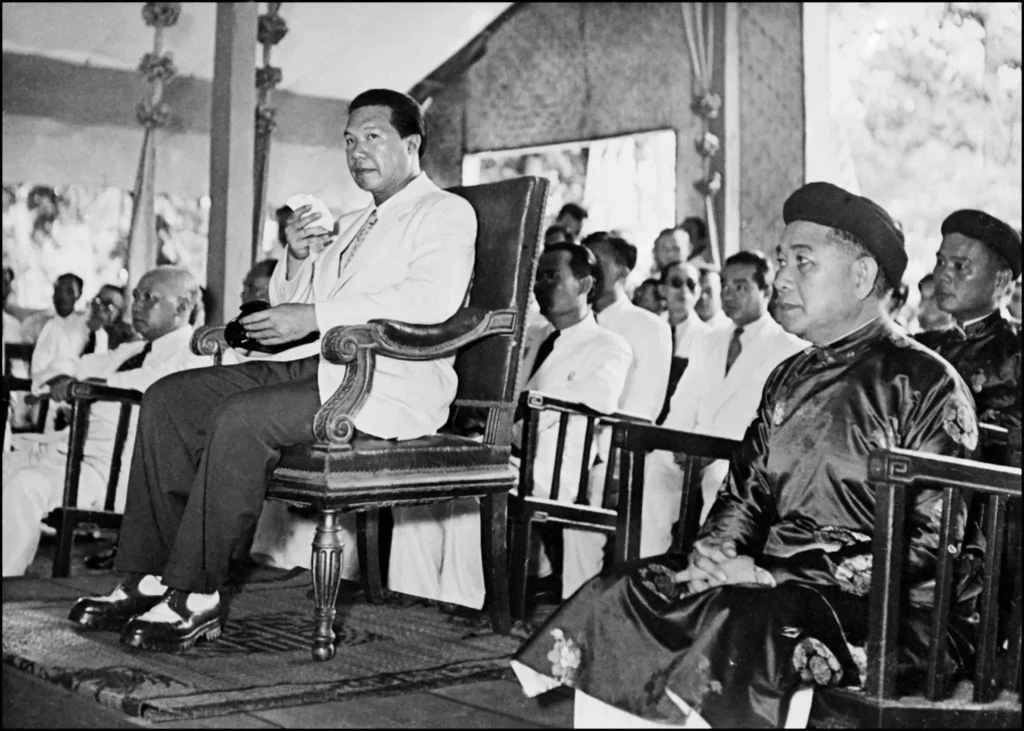
He was educated in Paris, drove fast cars, and wore a white suit better than most men alive. He spoke French like a native, loved tennis, and had a passion for hunting. He was also the Emperor of Vietnam — the last in a dynasty that had ruled for 143 years.
Bảo Đại ascended to the throne in 1926 at the age of twelve. By 1945, it was all over. And caught between the glittering world of the Forbidden City and the brutal tides of the 20th century was a woman who loved him — Nam Phương, Vietnam’s first and only Empress — and a story that still breaks hearts today.
For travel agents crafting itineraries through central Vietnam, the story of Bảo Đại and Huế’s Imperial City isn’t just history. It’s the emotional hook that turns a sightseeing stop into something your clients will talk about for years.
The Hue Imperial City history is filled with royal drama, political upheaval, and the tragic love story of the country’s last emperor, Bảo Đại.
Hue Imperial City History: A Boy Emperor in a Dying Dynasty
The Nguyễn dynasty had ruled Vietnam since 1802, but by the time Bảo Đại took the throne, real power had long since moved to the French colonial administration. He was emperor in title, in ceremony, in the silk robes and the golden throne — but not in much else.
Still, he tried. After his education in France, he returned to Huế with genuine ambitions to modernise the country. He cut the formal kowtowing ceremonies at court. He promoted talented commoners over entitled nobles. He — scandalously for the time — married a Catholic girl from a wealthy southern family for love.
| ❤️ Love story: In 1934, Bảo Đại married Nguyễn Hữu Thị Lan, a young woman he had met in Paris. He gave her the imperial name Nam Phương — meaning “Southern Fragrance” — and broke with centuries of tradition by crowning her Empress. Previous emperors had hundreds of concubines. Bảo Đại publicly declared he would have only one wife. |
The French press loved it. The Vietnamese court was horrified. And Nam Phương, beautiful, educated, and quietly dignified, became one of the most beloved figures in modern Vietnamese history.
The Forbidden City of Huế
While the dramas of Bảo Đại’s reign played out, the stage itself was extraordinary.
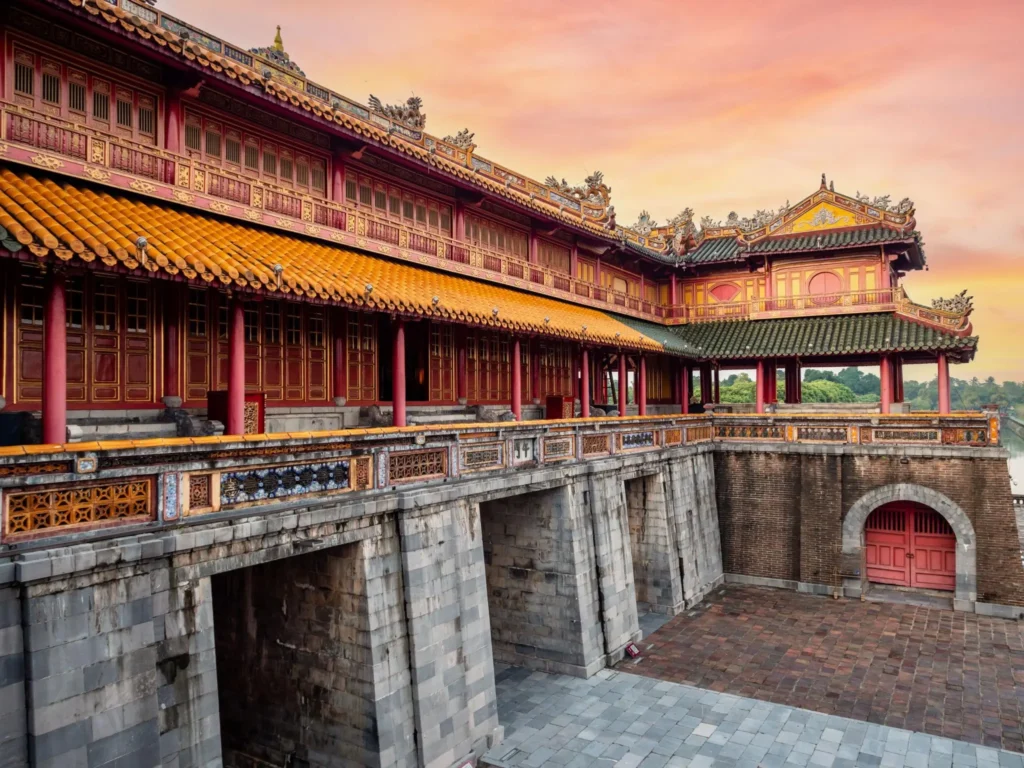
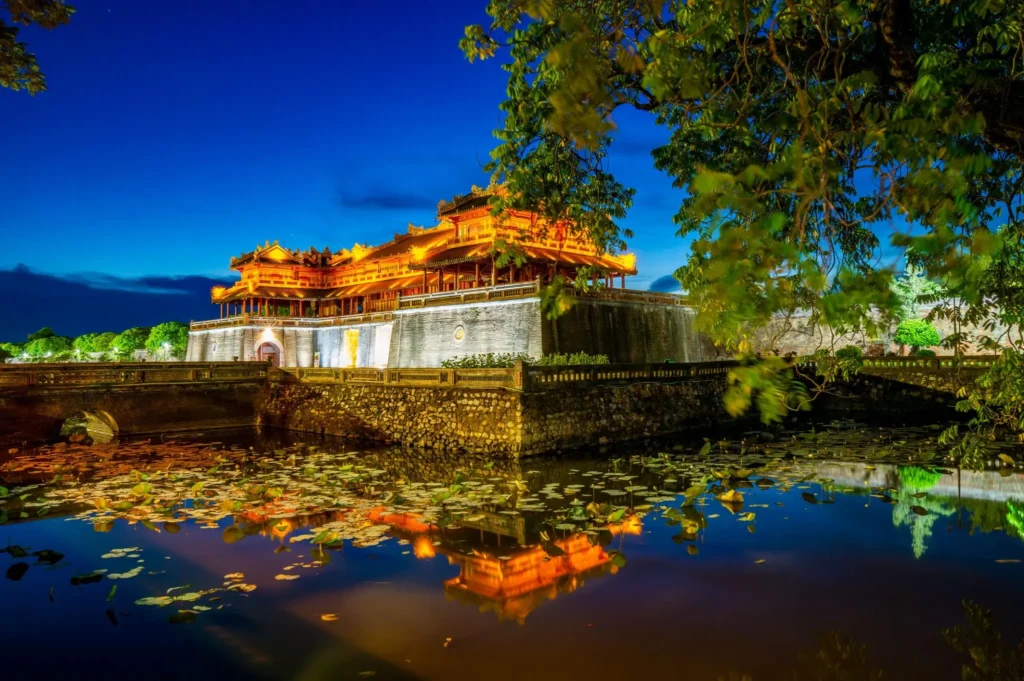
Hue Imperial Citadel — known as the Purple Forbidden City — was modelled on Beijing’s Forbidden City but built with a distinctly Vietnamese sensibility. Completed in 1833 under Emperor Minh Mạng, it sprawled across nearly 7 square kilometres, surrounded by a wide moat and massive stone walls.
Inside, a world of extraordinary ritual and beauty: pavilions with curved golden roofs, lotus ponds, banyan trees draped in moss, ceremonial gates where only the Emperor could walk. There were temples for royal ancestors, libraries of ancient texts, theatres for imperial performances, and the private apartments of the empress and concubines — a city within a city, hidden behind walls within walls.
| 🏛️ For your clients: Much of the Citadel was damaged during the 1968 Tết Offensive and the 1975 reunification. But major restoration work — funded partly by UNESCO — has brought significant sections back to life. Visiting today means walking through both history and active reconstruction, which adds to the atmosphere rather than diminishing it. |
The throne room, the imperial theatre, the royal reading pavilion — these survive and can be visited. The private quarters where Nam Phương lived with her five children are quieter, more intimate, and often more moving than the grand ceremonial spaces.
August 1945: The Day the Dynasty Ended
Japan had occupied Vietnam during World War II, using the French colonial infrastructure but increasingly pulling the real levers of power. When Japan surrendered to the Allies in August 1945, everything collapsed at once.
Ho Chi Minh’s Viet Minh moved quickly. A revolution was underway. And Bảo Đại, pragmatic and perhaps exhausted, made a decision that surprised everyone: he abdicated.
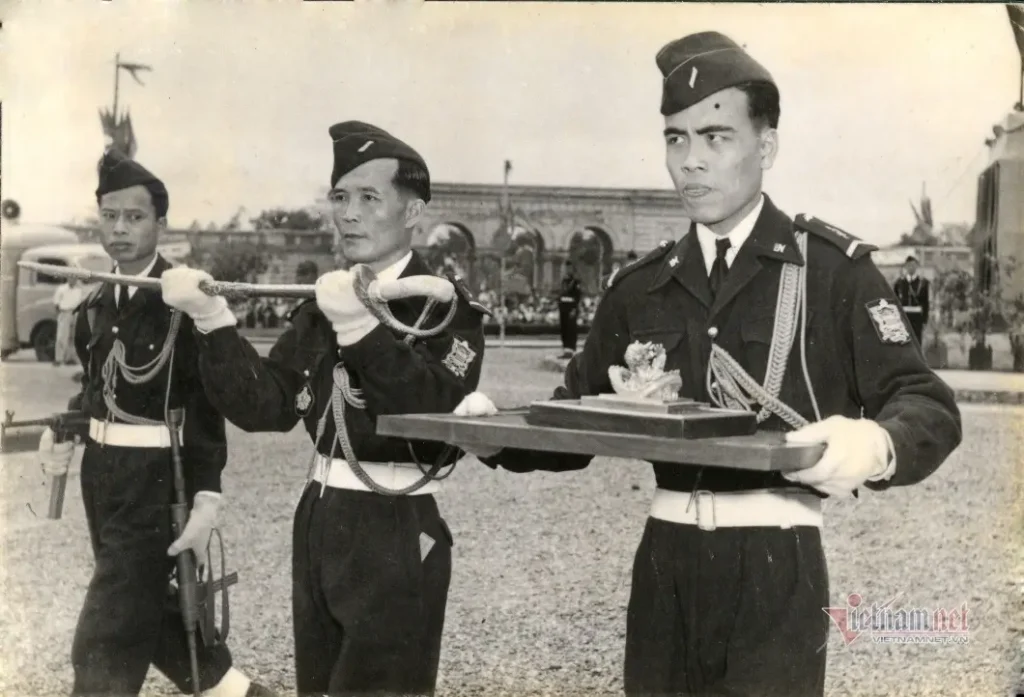
On August 25, 1945, standing before a crowd in Huế, he handed over the imperial seal and sword to Viet Minh representatives. He spoke words that have echoed through Vietnamese history ever since: “I prefer to be a free citizen in an independent country rather than an emperor in an enslaved one.”
It was, in its way, a dignified exit. The dynasty that had begun in 1802 ended not with a battle but with a speech and a handshake. Bảo Đại was 31 years old.
The Empress Who Refused to Follow
What happened next is where the love story turns genuinely heartbreaking.
After abdication, Bảo Đại briefly served as an advisor to Ho Chi Minh’s government — a deeply strange arrangement that lasted less than a year. He then went into exile in Hong Kong, and later France. He drifted. He gambled. He took a French mistress. He remarried, informally, multiple times.
Nam Phương did not follow him.
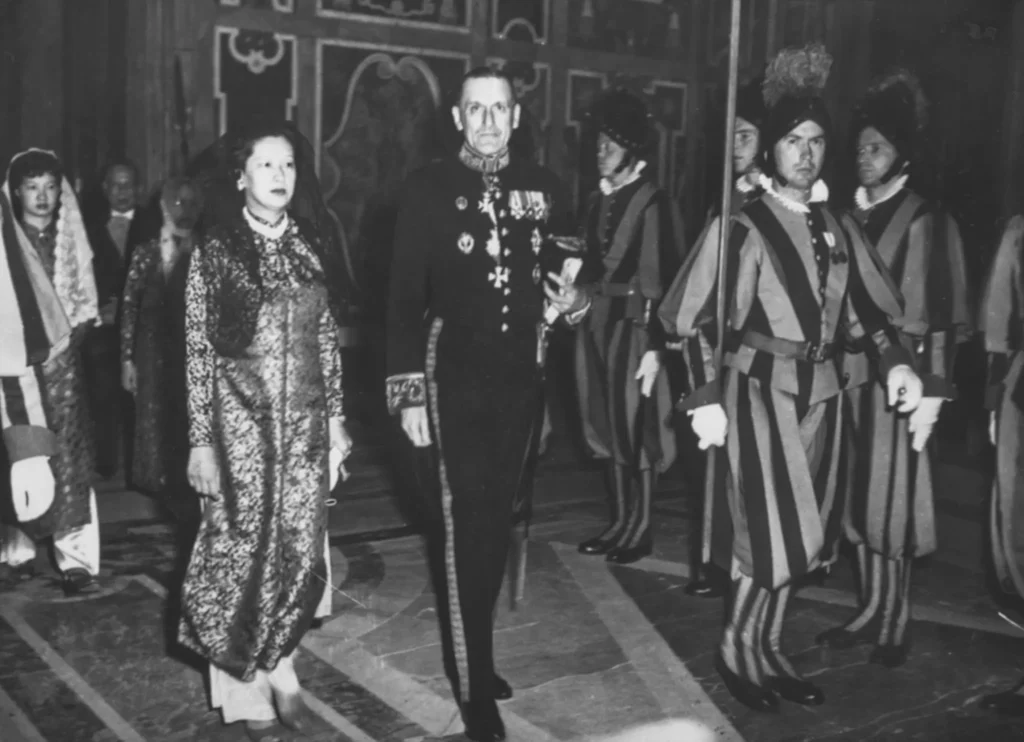
She retired to a small château in the French countryside — Chateau de la Perche in the Creuse — with their children, her Catholic faith, and whatever remained of her pride. She reportedly never spoke ill of Bảo Đại publicly. She tended her garden. She attended mass. She waited, perhaps, for something that never came.
She died alone in France in 1963, at the age of 49.
Bảo Đại outlived her by three decades, dying in Paris in 1997 at 83. They are buried in different countries.
| 💔 The sad postscript: Bảo Đại’s grave is in the Passy Cemetery in Paris, just a short walk from the Trocadéro and the Eiffel Tower. Nam Phương is buried near her château in rural France. Two halves of a love story that ended up on opposite sides of a continent. |
The Royal Tombs: Where the Dynasty Still Breathes
Bảo Đại may be the last emperor, but he was the thirteenth in his line. And scattered across the hillsides and pine forests surrounding Huế are the royal tombs of his predecessors — some of the most beautiful and atmospheric monuments in all of Vietnam.
Each tomb is essentially a self-contained palace complex, designed and built by each emperor during his own lifetime, according to his own aesthetic vision. No two are alike:
• Tự Đức’s Tomb — a poet-emperor’s romantic retreat of pavilions, lotus ponds, and shaded walkways. He had 104 wives and no children, and spent much of his reign here composing verse.
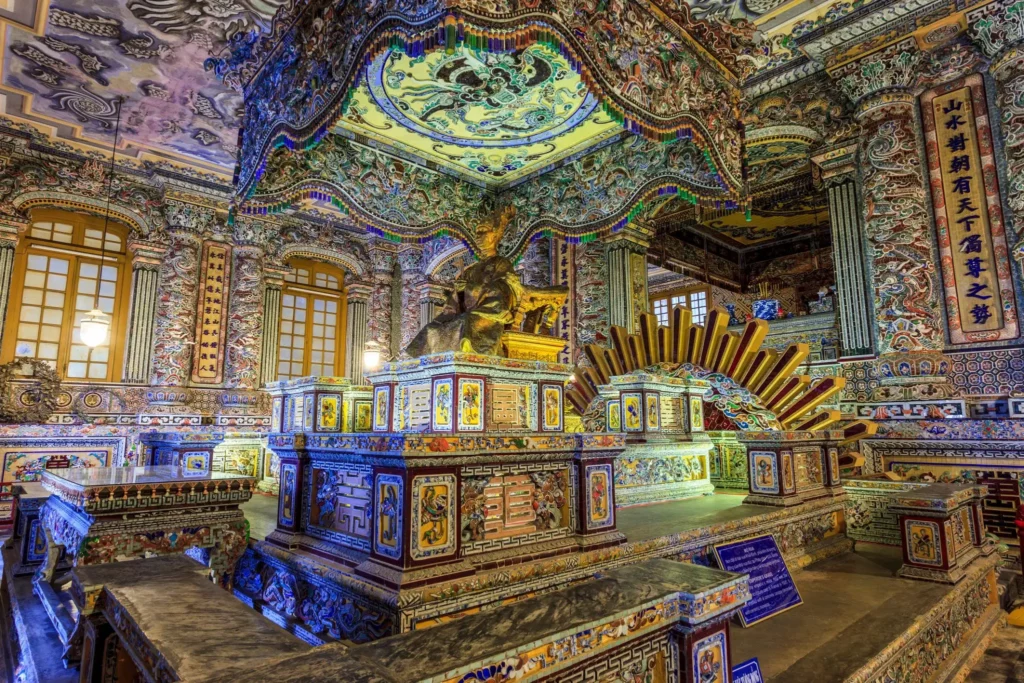
• Khải Định’s Tomb — a visual explosion of Art Deco meets Vietnamese tradition, covered inside with mosaics made from broken porcelain and glass. Bảo Đại’s own father, and a deeply controversial figure.
• Minh Mạng’s Tomb — the grandest of all: a vast symmetrical complex of gates, courtyards, and gardens that feels like a Vietnamese Versailles hidden in the jungle.
These aren’t ruins. They’re fully intact, richly decorated, and extraordinarily well-preserved. For clients who have been to Angkor Wat or the temples of Kyoto, the royal tombs of Huế offer something equally profound but far less crowded.
Why This Story Sells Huế to Your Clients
History is always more compelling when it has a human face. The story of Bảo Đại and Nam Phương gives Huế’s Imperial Citadel exactly that — a love story, a tragedy, and a moment when an entire world disappeared in a single afternoon.
For European travellers in particular, there’s an unexpected connection here. This emperor spoke their language, studied in their cities, and spent the last 50 years of his life on their continent. His story isn’t just Vietnamese history — it’s a mirror of the 20th century itself: colonialism, revolution, exile, and the people caught in between.
| 📋 TRAVEL AGENT TIPHue pairs exceptionally well with Hoi An on a central Vietnam itinerary — they’re just 120 km apart, connected by the famous Hai Van Pass (one of the most scenic coastal drives in Southeast Asia). Most clients book 2–3 nights in Hue and 3–4 nights in Hoi An. A private car over the Hai Van Pass is always a highlight. |
Explore the Imperial City With VietOne Travel
Ready to bring this story to life for your clients? Our itineraries through central Vietnam are built around exactly these kinds of experiences — guided visits that go beyond the surface and give travellers the context to really feel what they’re seeing.
Imperial Hue & Central Vietnam Tour — A dedicated exploration of Huế’s Citadel, Royal Tombs, and Thủ Thiêm Pagoda, with a private guide who brings the imperial story to life. Ideal for history-focused travellers.
Central Vietnam Discovery Package — Combines Huế, Huế’s Royal Tombs, the Hai Van Pass, and Hội An in one beautifully paced itinerary. Our most popular central Vietnam product for European agents.
Vietnam Highlights Tour — North to south: Hanoi, Ha Long Bay, Huế, Hội An, and Ho Chi Minh City. The full picture, for first-time visitors to Vietnam.
Tailor-Made Vietnam Itineraries — We specialise in custom itineraries for European and Russian travel agents. Contact our team to build something around your clients’ exact interests.
The Emperor Is Gone. The City Remains.
Bảo Đại’s abdication speech lasted ten minutes. The dynasty that preceded him had lasted a century and a half. And the city he left behind — the moated Citadel, the lotus ponds, the golden throne rooms, the royal tombs in the pine forests — still stands, still breathes, still holds the weight of everything that happened there.
Your clients won’t just be visiting a UNESCO World Heritage Site. They’ll be walking through the last chapter of a story that began in 1802 — and ended, quietly and irreversibly, on a August afternoon in 1945, when a young emperor in a white suit handed over his seal and walked away from everything his family had built.
Some places hold history in their stones. Huế holds it in the air.
Ready to make Central Vietnam your next big product launch?